Well-Architected Review Loop
Run AWS Well-Architected as a repeating operating loop across six pillars — not a one-time slide — with named risks, owners, and a next-workload date.
Harvested from AWS Professor / Lesson_002 Well-Architected Framework Six Pillars + Operator-AI AWS Assessment module
View source in repo →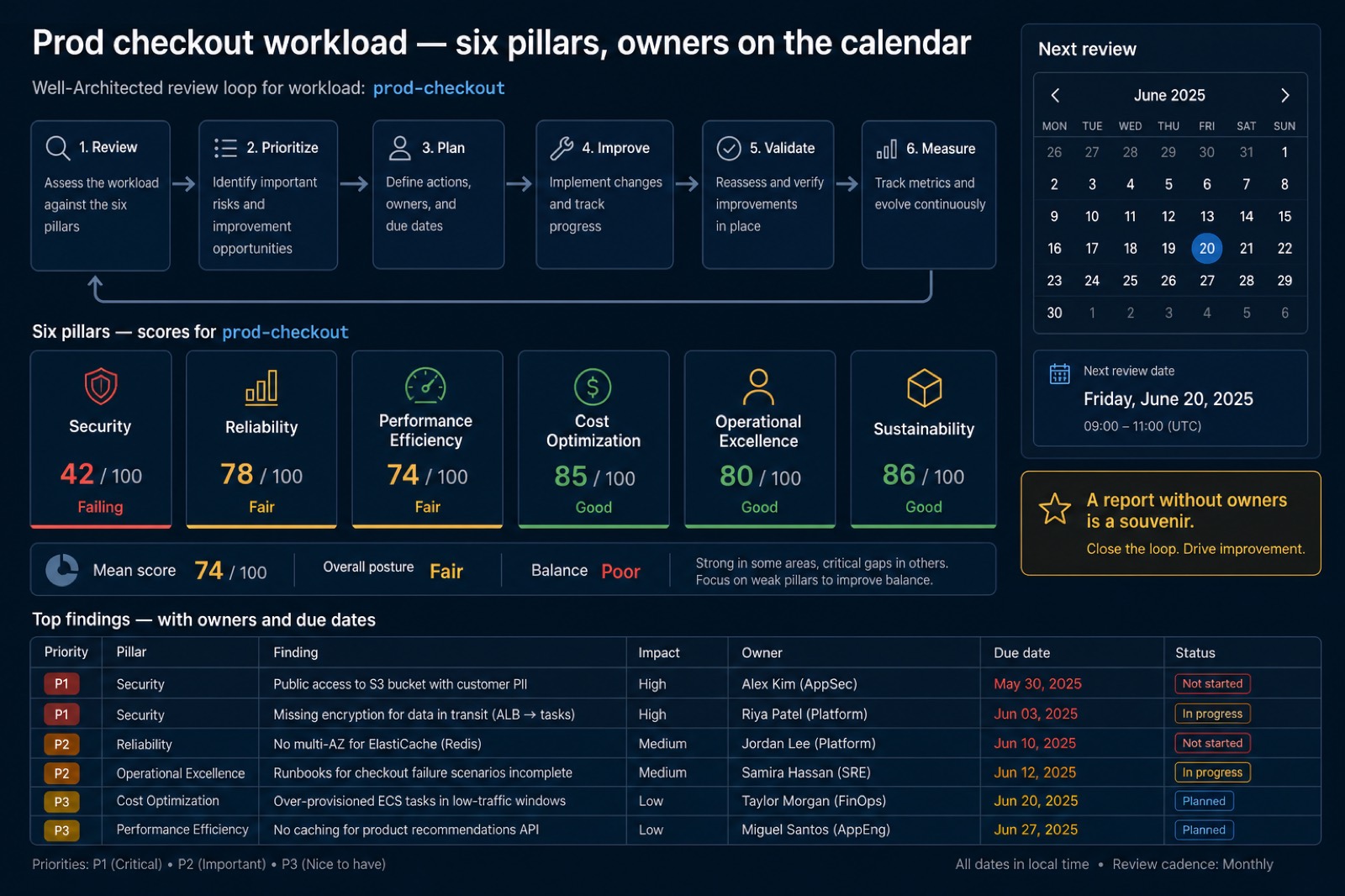
When not to use
A greenfield sketch with no workload yet. Review real systems; don't score a deck.
Problem
Teams treat Well-Architected as a certification checkbox or a consultant's PDF. Six months later nothing has owners. The framework only pays off as a loop: score a named workload against the six pillars, write risks with owners, schedule the next review, and refuse to let "we'll get to security later" hide inside an average.
Shape
Named workload (not "the AWS account")
        ↓
Six pillars: Operational Excellence · Security · Reliability
             Performance Efficiency · Cost Optimization · Sustainability
        ↓
Per-pillar findings  →  risks with owner + due date
        ↓
Balance check: a high mean with a failing Security pillar is not healthy
        ↓
Remediation backlog  →  next review date on the calendar
Same balance-score instinct as C.I.T.H.: the weak pillar is the finding. Operator AI's AWS Assessment module is this loop productized.
Key decisions
- Review a workload, not an account. "Prod checkout" and "analytics lake" have different risks.
- Every finding has an owner and a date, or it is a slide.
- Cost is a pillar, not a finance afterthought. Token and egress spend belong here for AI workloads.
- Sustainability is in the framework — treat it as capacity and waste, not marketing.
- Re-review on a cadence (quarterly, or after a material change), not after an incident.
Failure modes
Averaging six pillars into a gold badge hides a missing encryption finding. Reviewing "AWS" instead of a workload produces generic advice. A report without owners is a souvenir. Running the review only to unlock a partner credit, then archiving the PDF, is the anti-pattern this loop exists to prevent.
Scaling path
One workload, six pillars, a spreadsheet if you must. Promote to Operator AI's AWS Assessment when you want evidence pointers and a dashboard. Multi-account is a later problem — get the loop honest on one production workload first.