Synthetic Data and Evaluation Loop
Fictional companies, daily scenarios, and hidden ground truth so you can score extraction quality before any real client data is in the system.
Harvested from Operator-AI / 01_Synthetic_Companies, 06_Ground_Truth, 07_Evaluations + master spec §14–16
View source in repo →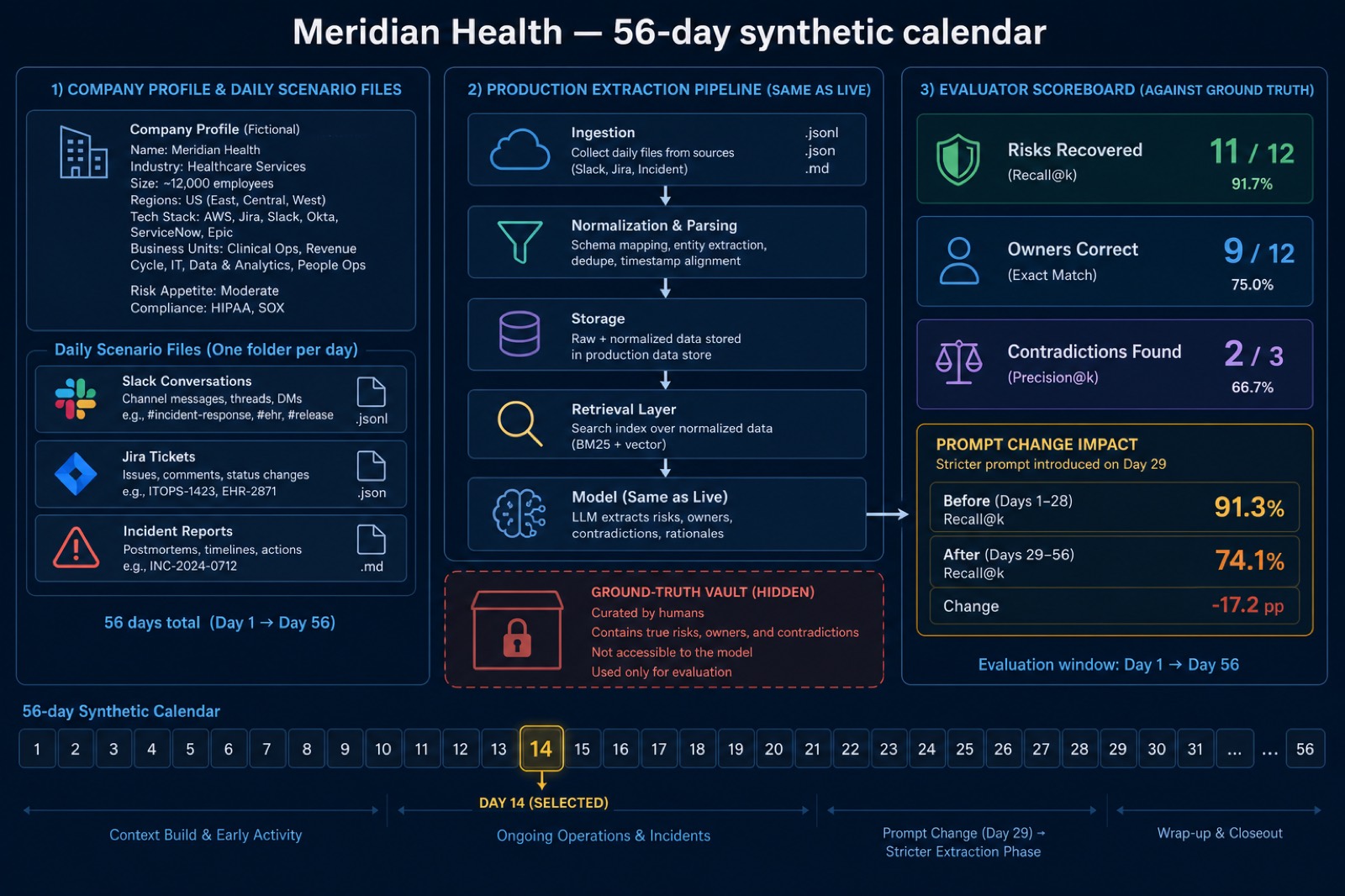
When not to use
A one-shot demo with no intention to measure quality over time. If you cannot name a score, skip the synthetic factory.
Problem
You cannot tune an extraction pipeline on real client data you do not yet have, and you should not. You need fictional-but-realistic companies, a daily stream of operational events, and hidden ground truth so a scorer can tell whether the model recovered the risks, owners, and contradictions you planted.
Shape
Synthetic company profile
        ↓
Daily scenario generator  (Slack, Jira, email, incidents, AWS findings…)
        ↓
Raw public-style signals     +     hidden ground truth (not in the model context)
        ↓
Same production pipeline (ingest → extract → persist → brief)
        ↓
Evaluator compares operating objects to ground truth
        ↓
Quality score → prompt / schema / rule change → replay
Drive layout: 01_Synthetic_Companies, 02_Daily_Scenarios, 06_Ground_Truth, 07_Evaluations. Advance a 56-day calendar per account rather than generating one giant dump.
Key decisions
- Ground truth never enters the model context. If it does, you are testing regurgitation.
- The production pipeline is the thing under test. A separate "eval prompt" that does not run in prod is a different product.
- Score what the schema cares about (risk recovered, owner correct, contradiction flagged), not BLEU on the brief prose.
- Advance time on a calendar so trend, missed deadlines, and compounding risk are testable.
Failure modes
Leaking ground truth into the scenario text makes scores look great and production look random. Scoring the brief's fluency instead of the objects hides extraction bugs. A static synthetic dump goes stale the moment the schema changes — regenerate from the company profile. Using real client names "for realism" is how you get a compliance incident in a test folder.
Scaling path
Start with one company and 14 days. Add industries once scores are stable. Wire the evaluator into CI so a prompt change that drops recall cannot merge. Only then point the same pipeline at a real (contracted, minimized) artifact set.