Experience Intelligence Assessment Pipeline
RFP-grade CRO/UX assessment: crawl, Playwright journeys, Lighthouse, axe-core, and AI interpretation into an evidence-backed, prioritized backlog.
Harvested from experience-intelligence-platform — Drive/GitHub RFP-grade CRO assessment
View source in repo →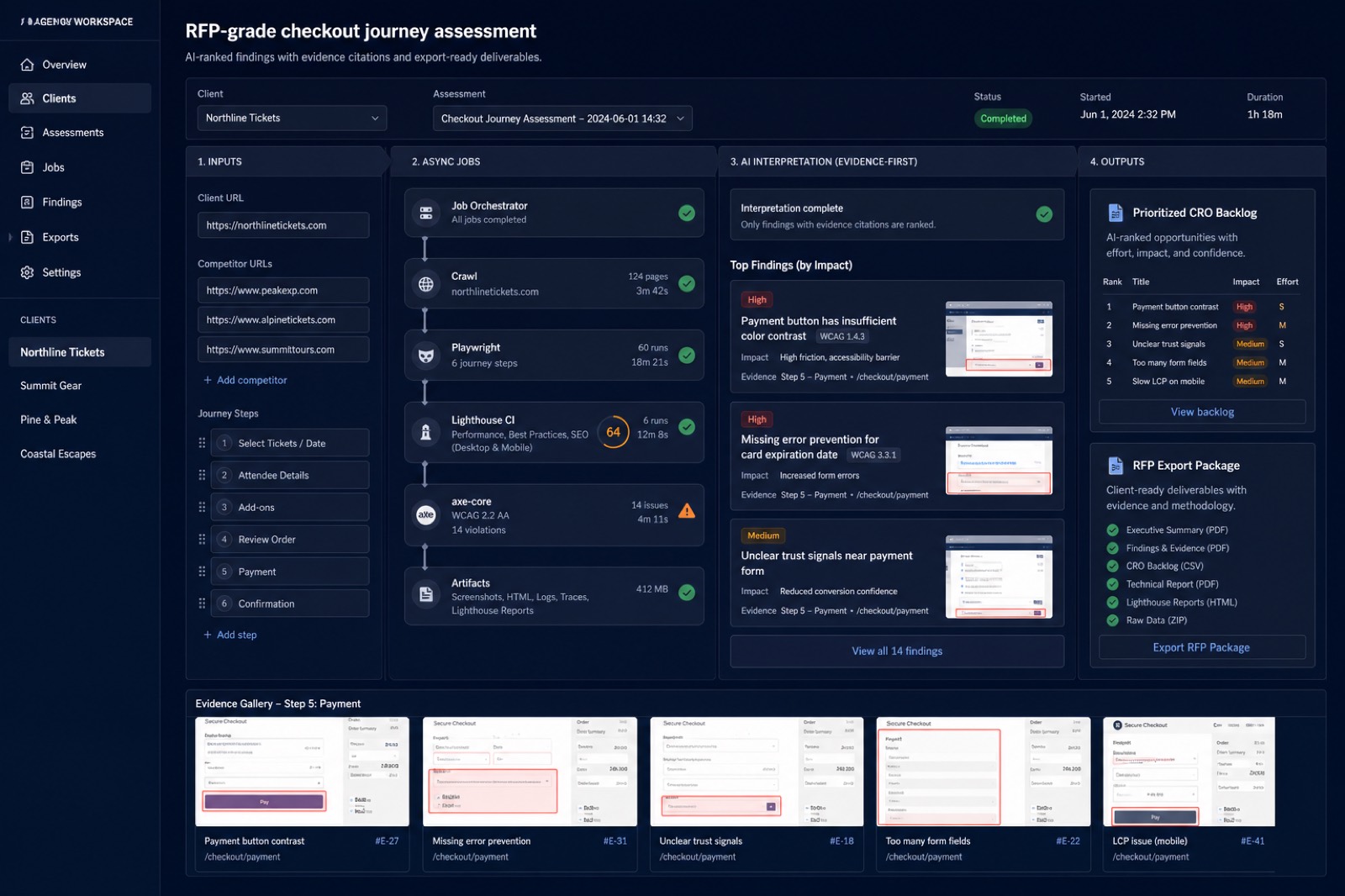
When not to use
A one-page Lighthouse paste. If you are not collecting journey evidence, you do not need this pipeline.
Problem
Agencies and consultants still produce CRO/UX recommendations from a slide instinct. Buyers want RFP-grade evidence: what was crawled, which journeys ran, what Lighthouse and axe said, and why the model ranked a finding — in a backlog they can staff.
Shape
NEW ASSESSMENT → client → URL → competitors → objective → journey
        ↓
RUN  →  crawl  →  Playwright  →  Lighthouse  →  a11y (axe-core)  →  AI interpretation
        ↓
Evidence-backed findings  →  prioritized CRO backlog  →  RFP output
Three product layers: Assessment Engine, Agency Workspace (clients, collaboration, deliverables), Benchmarking (industry / franchise intelligence). Stack: Next.js, Vercel, Supabase, Trigger.dev jobs, Playwright, axe-core, Lighthouse. Local JSON store under .data/ so the app runs without Supabase in development.
Key decisions
- Evidence before interpretation. The AI ranks findings that instruments produced; it does not invent them.
- Jobs are async (see Async Job Processing). A crawl is not a request.
- Agency workspace is multi-tenant with client records, not a folder of PDFs.
- Companion toolkit stays outside the product (Clarity, GA4, Search Console, WAVE) — don't rebuild analytics, ingest its exports.
- Degrade to a local store so development never blocks on cloud credentials.
Failure modes
Running AI on a URL with no crawl evidence produces confident fiction. Blocking the UI on Playwright makes the assessment feel broken. Mixing competitor URLs into the same evidence bag without a source tag poisons the backlog. Treating Lighthouse scores as the recommendation (instead of as one evidence stream) is the old PDF report with extra steps.
Scaling path
V0.1 persists the assessment and detail page. Next: the job runner, then AI interpretation with citations back to artifacts, then RFP export. Benchmarking is a third layer — do not delay the engine to build a data network.