Deterministic Operator Pipeline
Explicit ingest → extract → validate → persist → retrieve → brief stages. No multi-agent orchestration in the proof of concept.
Harvested from Operator-AI / 13_Architecture / ADR-001-deterministic-pipeline.md
View source in repo →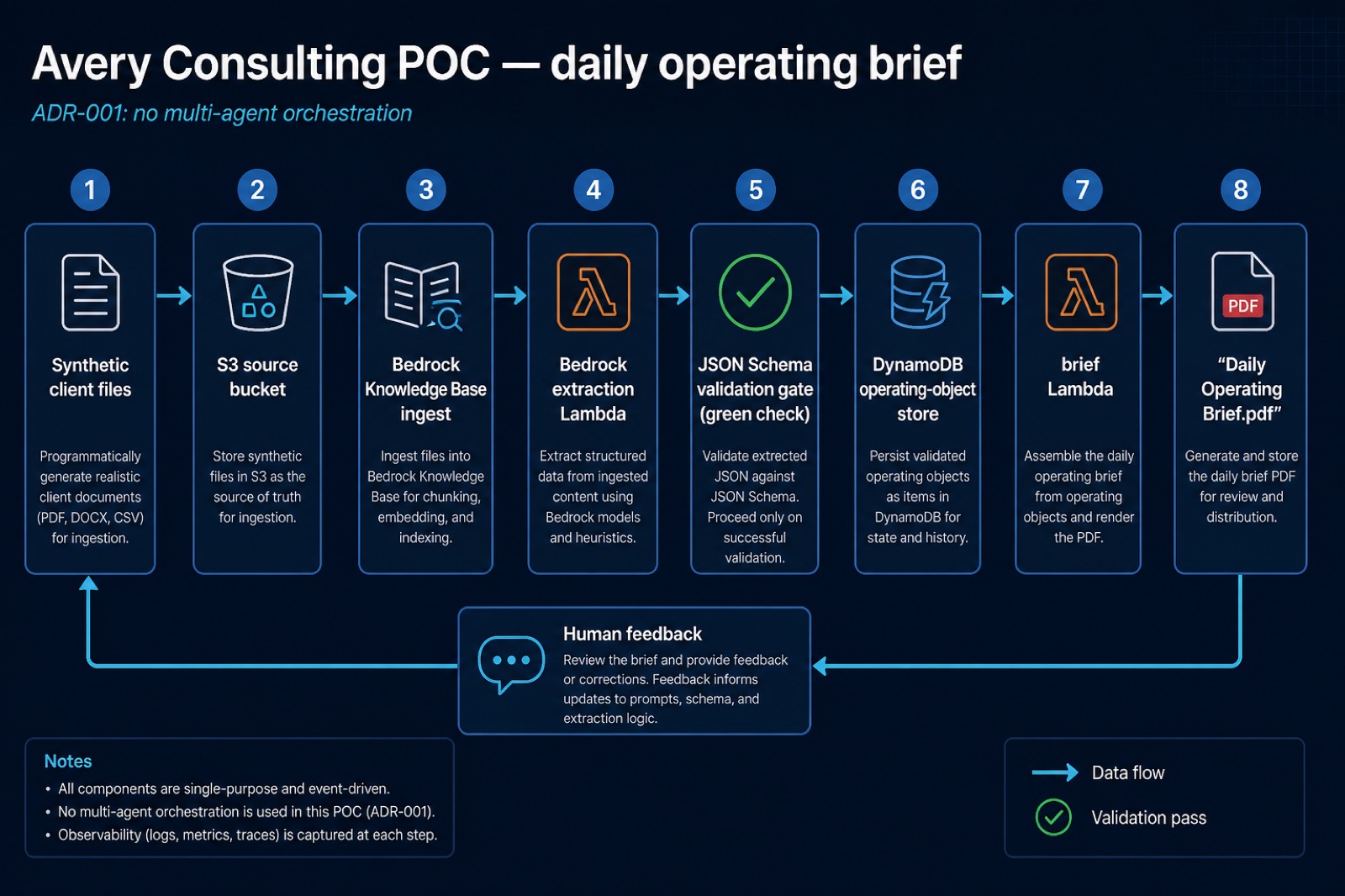
When not to use
A research sandbox where autonomous tool use is the point. This pattern is for operating intelligence that must be debuggable, evaluable, and unable to mutate business systems on its own.
Problem
Agentic orchestration looks powerful in a demo and then becomes undebuggable in a consulting product: you cannot tell which step hallucinated, you cannot evaluate a stage in isolation, and an agent with write tools can mutate Jira, Slack, or a CRM without a human in the loop.
Shape
Synthetic files / client artifacts
    ↓
S3 source bucket
    ↓
Bedrock Knowledge Base ingestion
    ↓
Bedrock extraction invocation
    ↓
JSON Schema validation
    ↓
Operating-object store (DynamoDB)
    ↓
Retrieval + prioritization
    ↓
Daily Operating Brief
    ↓
Human feedback
ADR-001: use explicit stages. Do not introduce multi-agent orchestration in the POC. Initial AWS footprint is one account, one S3 bucket (source + generated prefixes), one Bedrock Knowledge Base, one least-privilege IAM role, one DynamoDB table, two Lambdas (extract + brief), CloudWatch logs.
Key decisions
- Deterministic workflow before agentic orchestration — easier to debug, evaluate, cost, and bound. Each error has an owner stage.
- JSON Schema validation between extraction and persistence so a bad model response cannot corrupt the operating-object store.
- Human feedback is a stage, not an afterthought — the loop closes on a person, not on an autonomous write.
- Least-privilege IAM execution role — the pipeline can read artifacts and write objects; it cannot ticket, email, or page on its own.
Failure modes
Skipping schema validation lets a drifted prompt silently write garbage objects. Collapsing stages into one "agent" means a failure in retrieval looks identical to a failure in extraction. Giving the POC write tools "just for the demo" is how you get an autonomous mutation of a client's system. Bedrock KB ingestion lag makes the brief look stale — surface ingestion status, don't hide it.
Scaling path
Keep this shape through the POC and the first paid accounts. Promote individual stages to Step Functions + EventBridge when you need retries, fan-out, and a visible state machine — that is a new ADR, not a silent rewrite. Multi-agent orchestration is a later ADR, and only after evaluation scores prove a stage is the bottleneck rather than the model.