Bedrock Knowledge Base Extraction Pipeline
S3 artifacts into a Bedrock Knowledge Base, schema-validated extraction into DynamoDB, briefs generated on a schedule — the AWS shape behind Operator AI.
Harvested from Operator-AI master spec §18 AWS Architecture + ADR-001 initial resources
View source in repo →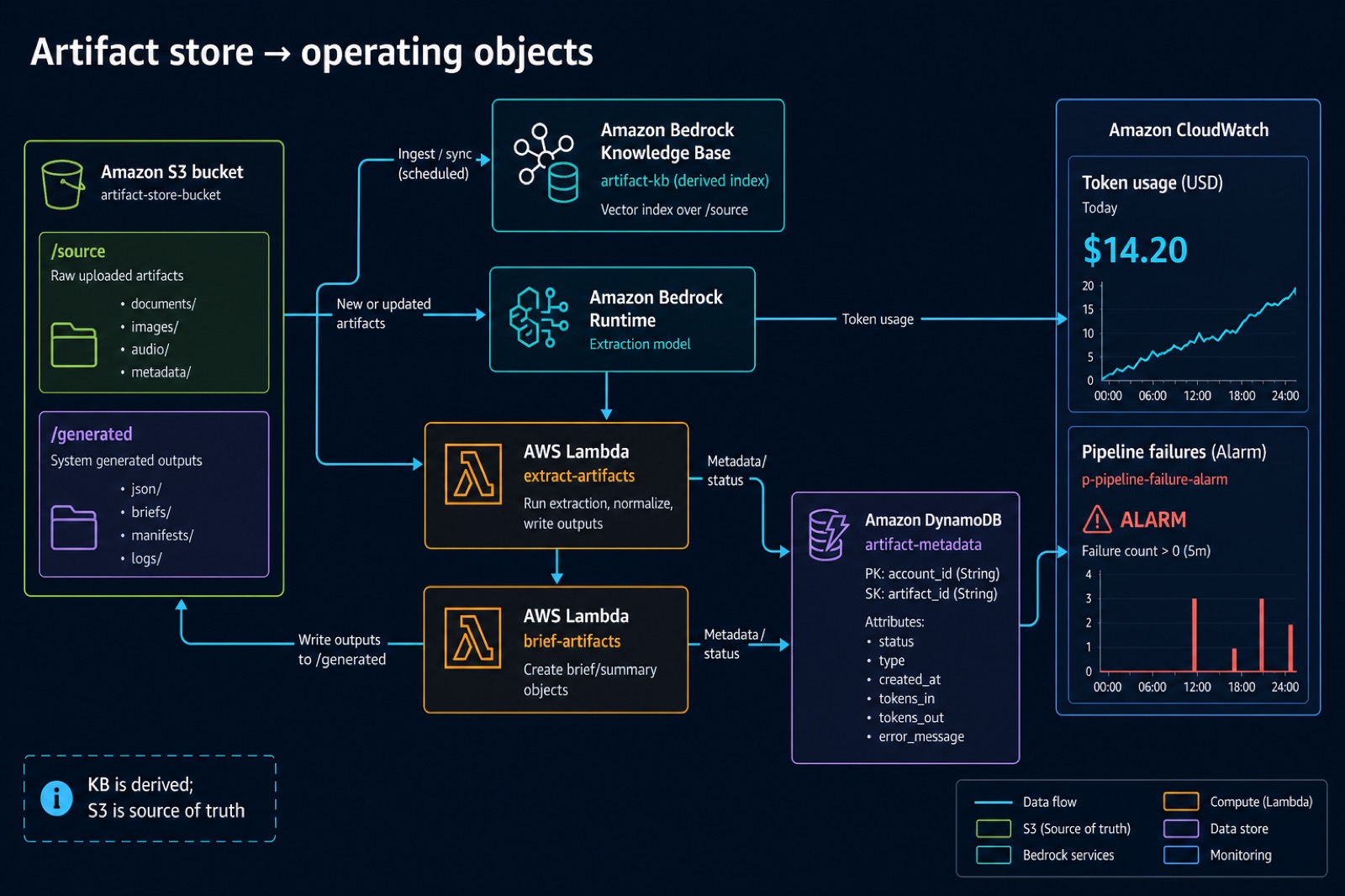
When not to use
A single-document Q&A toy, or a workload that must not leave your VPC without a private Bedrock setup you are ready to operate.
Problem
You have artifacts in object storage and you need structured operating objects out the other side — not a chatty RAG demo. Extraction must be invocable, validatable, and cheap enough to run on a daily brief cadence.
Shape
Frontend
  ↓
FastAPI or API Gateway
  ↓
Application service
  ├── Bedrock Runtime          extraction, classification, reasoning
  ├── Bedrock Knowledge Base   retrieval over S3 artifacts
  ├── DynamoDB                 accounts, risks, commitments, decisions, evals
  ├── S3                       artifacts, scenarios, prompts, exports
  ├── Step Functions           orchestration (next layer)
  ├── EventBridge              daily / weekly triggers (next layer)
  ├── Lambda                   extract + brief generation
  └── CloudWatch               logs, cost, token usage, pipeline failures
Key decisions
- S3 is the artifact system of record; the Knowledge Base is a derived index. Rebuild the index from S3, never the other way around.
- DynamoDB holds operating objects, not raw documents. Keep access patterns in the schema (account_id partition, typed sort keys).
- Bedrock for extraction and reasoning, not for durable state.
- CloudWatch on token usage and pipeline failures — LLM cost is an ops metric, not an invoice surprise.
- Next layer (new ADR): Step Functions for orchestration, EventBridge for the daily brief trigger. Do not smuggle them into the POC.
Failure modes
Treating the Knowledge Base as source of truth means a failed ingestion silently drops evidence. Unbounded Bedrock context or retries blow the token budget — cap both and alarm. A single IAM role that can invoke Bedrock *and* write to production ticketing is how the action layer leaks into the POC. DynamoDB without a typed sort-key convention becomes an unqueryable blob store.
Scaling path
One bucket, one table, two Lambdas, one KB is the POC. Add Step Functions when you need visible retries and fan-out. Add EventBridge when the brief must run unattended. Add a vector store beside the KB only when retrieval quality, not orchestration, is the measured bottleneck.