Agent Spend Control Without a Gateway
Detect-and-cut AI coding-agent spend from read-only admin APIs: per-developer burn, a minutes-scale kill switch, and client chargeback — no traffic proxy.
Harvested from ARC Labs / TokenLoop (tokenloop.vercel.app) — live free product
View source in repo →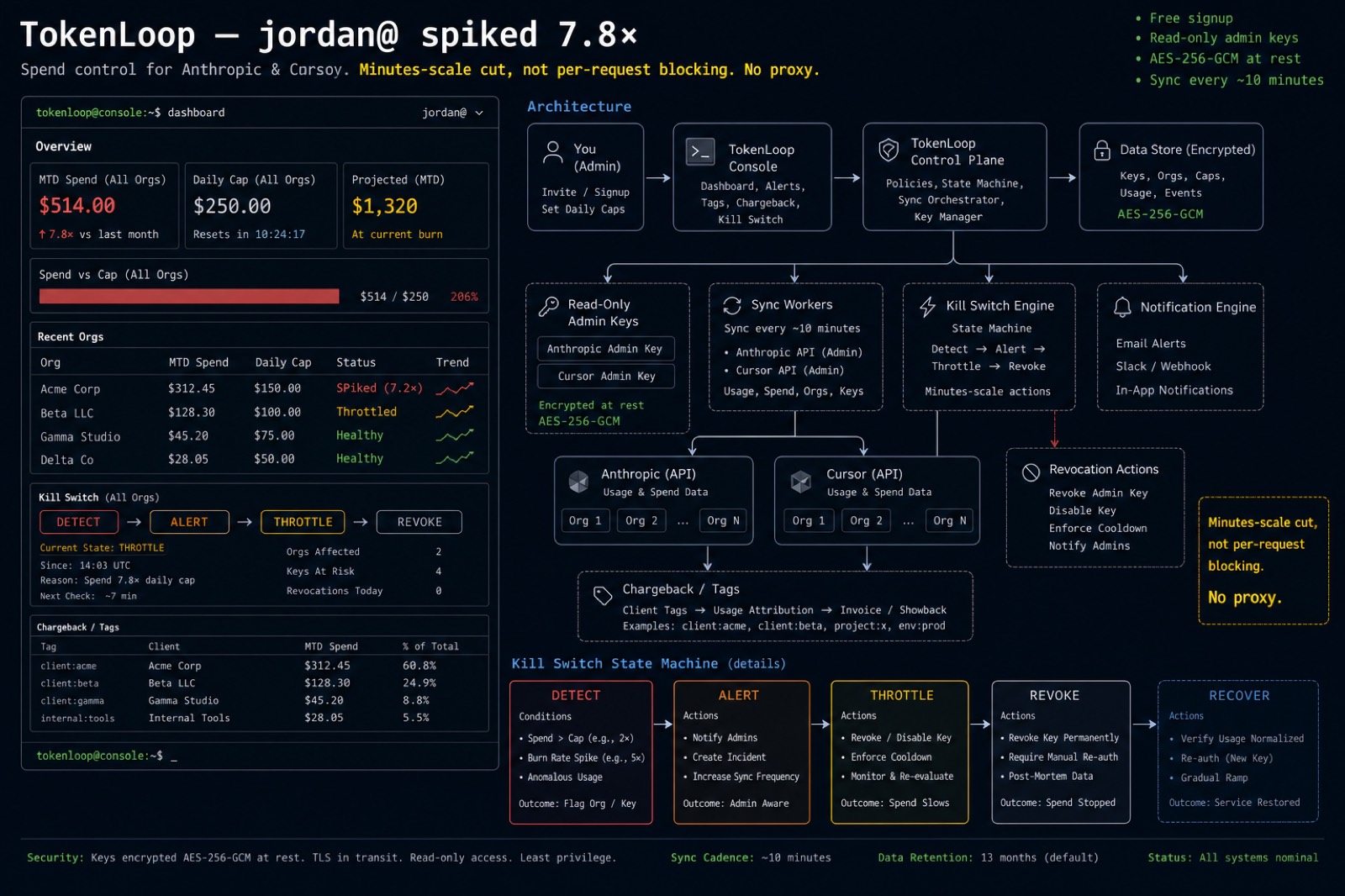
When not to use
When you need true per-request blocking. A minutes-scale kill switch cannot stop a token already in flight. Don't pretend otherwise.
Problem
Engineering and agency leads running Claude Code and Cursor find out about runaway spend on the invoice. They need detect-and-cut plus client bill-back without rebuilding all traffic through a proxy they do not want to operate.
Shape
Free signup (email + password)
        ↓
Read-only admin keys  (Anthropic / Cursor)
        ↓
AES-256-GCM encrypt at rest  — never returned to the browser
        ↓
Periodic sync  (~10 min)  →  per-developer burn, spike multiplier
        ↓
Policy: daily cap / spike threshold
        ↓
Kill switch: detect → alert → throttle or revoke via admin APIs
        ↓
Optional chargeback: tag clients, markup, CSV export
No gateway. The system observes admin APIs and acts through them. Honest scope: minutes-scale cut, not true per-request blocking.
Key decisions
- No proxy. Inserting a gateway would catch more, and would also become an availability and privacy surface most teams will not accept for a free tool.
- Keys encrypted at rest, never echoed back. Signup exists so secrets have an org to belong to — not to unlock paid tiers.
- Kill switch is a state machine (detect / alert / throttle / revoke), not a single button.
- Chargeback is a view on the same spend data, not a second ingestion path.
Failure modes
A 10-minute sync window can miss a flash spike — say so on the dashboard. A revoke that the provider API delays looks like a broken kill switch; show last-action status. Storing keys in localStorage "just for the session" is how they leak. Treating this as a replacement for procurement-level budget controls oversells it.
Scaling path
Add providers (Codex / OpenAI) as additional read-only ingestions behind the same policy engine. Tighten sync frequency only where the provider API allows it. A real per-request gateway is a different product with a different trust model — do not sneak it into this shape.